
Deck Foundations
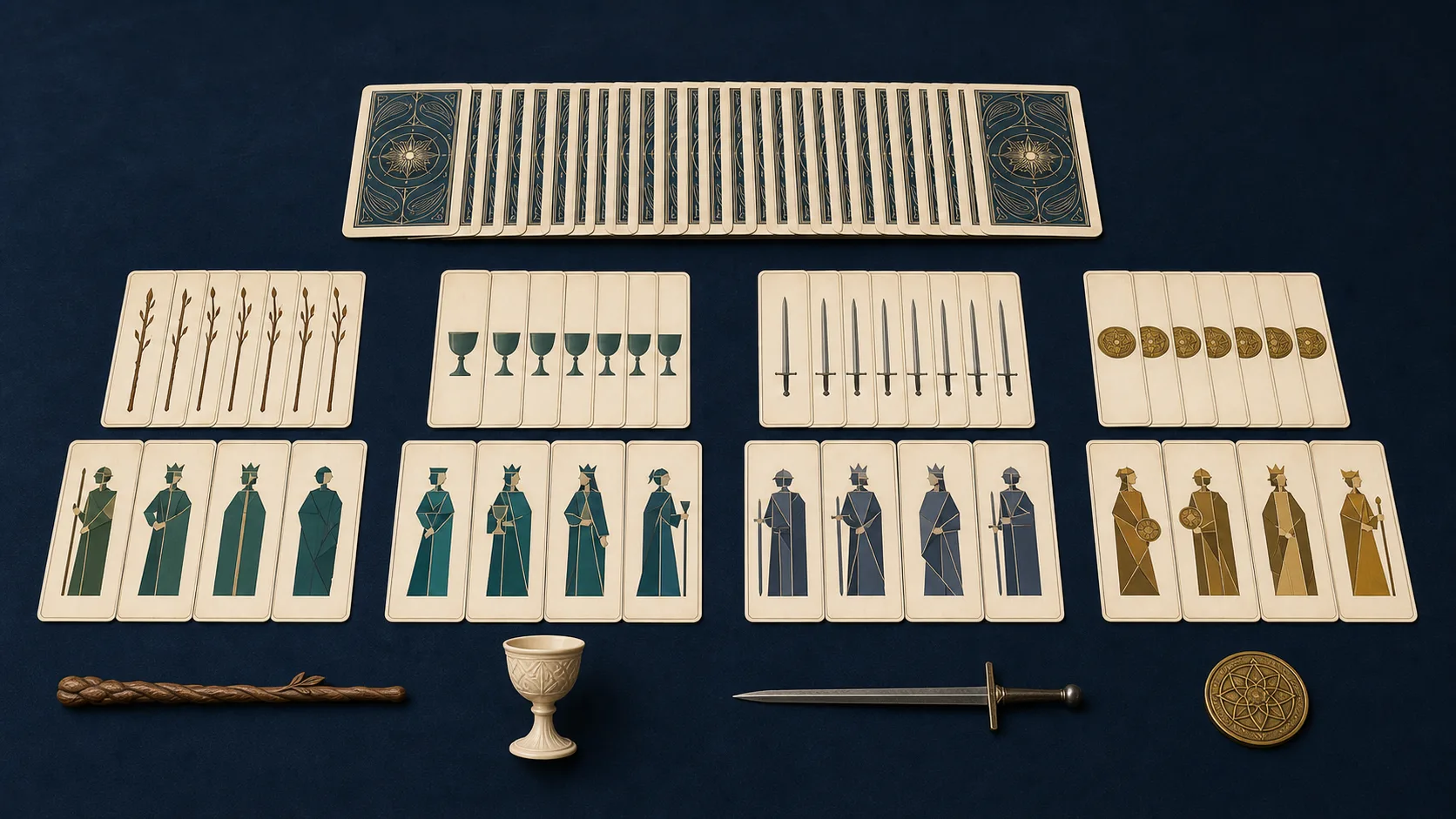
Understand how a 78-card tarot deck is organized into 22 Major Arcana and 56 Minor Arcana cards, including four suits, numbered cards, and court cards.
Study the complete deck, symbolism, questions, spreads, card relationships, and ethical reading synthesis.

Tarot becomes easier to learn when deck structure, visual observation, spread position, and card relationships work together. The course moves from seeing one card clearly to conducting complete readings.
Understand how a 78-card tarot deck is organized into 22 Major Arcana and 56 Minor Arcana cards, including four suits, numbered cards, and court cards.

Read color, landscape, gesture, direction, objects, contrast, number, element, and archetypal themes before reaching for a memorized keyword.

Frame open, useful questions; choose the smallest spread that fits; and read position, sequence, repetition, contrast, direction, and elemental relationships across cards.

Move from individual card observations into patterns, a coherent narrative, reflective options, practical next steps, uncertainty, and a respectful reading close.
The curriculum follows a card-to-reading sequence: deck structure, symbolic observation, question framing, spread positions, card relationships, synthesis, journaling, and ethical boundaries.
Practice separates observation, card meaning, spread position, synthesis, and reflection so readings can be reviewed instead of guessed.
Train your eye to describe visible details before choosing a meaning.
Connect card meanings through arcana, suit, element, number, and role.
Give each card a clear job so the spread stays focused.
Turn card observations and relationships into a clear reading summary.
The outcomes focus on a repeatable reading workflow, structured symbol interpretation, thoughtful question design, and ethical communication.
Move from question to card-by-card reading, synthesis, and closing notes.
Interpret cards through visible evidence, structure, and context.
Create useful questions and choose layouts that fit the reading goal.
Read with consent, privacy, boundaries, uncertainty, and agency.
Designed for beginners and developing readers who want a structured, agency-preserving tarot method and are willing to observe the full spread before making conclusions.
You want an ordered path through all 78 cards without relying only on memorized keywords.
You want tarot as a structured tool for journaling, perspective, and thoughtful conversation.
You know some card meanings but want stronger questions, spreads, synthesis, and session flow.
You want a consent-based reading structure with privacy, agency, records, and referral boundaries.

The course pairs live demonstrations with card-study sheets, symbolism journals, spread templates, question-reframing exercises, practice readings, and ethical session structures.
Study deck structure, card groups, symbolism, spreads, and complete readings through demonstrations.
Use templates for observation, traditional meaning, deck imagery, context, and reflection.
Practice one-card, two-card, three-card, decision, relationship, and larger layouts.
Review difficult cards, reversals, court cards, contradictions, and question boundaries.
Work through prepared and consented cases with a repeatable session and feedback structure.
Protect consent, privacy, agency, wellbeing, and professional scope in every reading.
Batch-specific timing, recording availability, teaching language, and completion details are shared during registration.
Clear answers about prerequisites, decks, all 78 cards, memorization, reversals, spreads, predictions, ethical boundaries, course materials, and professional scope.
Share your details and we'll send the course outline, learning flow, and next-step guidance.